Disorders of Consciousness Program
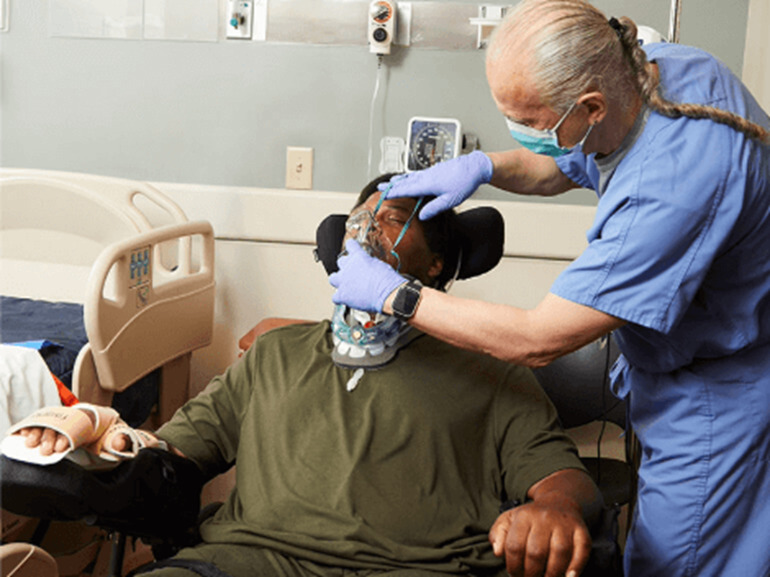
About the program
The DoC program focuses on patients who have sustained one of the following:
- A severe, traumatic acquired brain injury
- An anoxic brain injury
- A stroke resulting in an unresponsive wakeful or a minimally conscious state
Kessler Institute’s DoC program is overseen by a board-certified brain injury physician and offers patients a highly integrated program of medical management, nursing care and therapy interventions. Doctors use standardized measures and advanced technologies to evaluate and improve function in individuals with DoC. Our DoC program meets and exceeds all requirements for treating persons with disorders of consciousness set forth by the American Congress of Rehabilitation Medicine and the Traumatic Brain Injury Model Systems (TBIMS) program, sponsored by the National Institute on Disability, Independent Living, and Rehabilitation Research (NIDILRR).
-
The goals of the program include addressing responsiveness and, to the best extent possible, identifying a means of communication for the patient. We do this by:
- Encouraging re-emergence of awareness to self and environment
- Establishing a communication framework to promote interaction with the external world
- Optimizing physical conditioning to prevent loss of strength and range of motion
- Advancing the patient through stages of treatment to improve physical and cognitive functioning
- Providing family-centered support and training throughout the recovery process
-
We follow an evidence-based plan of care, using clear, uniform assessments for patients and creating an environment that strengthens thinking skills and promotes recovery. Specific methods may include:
- Bracing, positioning and wheelchair seating
- Muscle tone normalization and spasticity management
- Medication targeted to treat the nervous system including the brain and spinal cord
- Nutrition intervention
- Pain management
- Respiratory therapy
- Responsiveness/arousal facilitation (methods to stimulate the brain)
- Sensorimotor stimulation or therapy to help the brain properly process sensory information
- Sleep pattern regulation
-
We understand transitions can be complex, and we strive to make the admission process as smooth as possible. To ensure we receive all necessary medical information for a proper review, all referrals must be submitted by the acute care facility, usually the case manager, where the patient is currently located.
If you are a family member or physician, please encourage the current facility’s case manager to contact us. Each patient referred is given individual consideration and admission decisions are made in consultation with the DoC team.
Patients appropriate for Kessler Institute’s DoC program are no longer in a coma (meaning their eyes are open at least some of the time), but have not regained a level of consciousness that allows them to respond consistently to their environment, communicate reliably or complete basic self-care activities.
In general, appropriate candidates exhibit the following characteristics:- In the acute and subacute phases of recovery
- Medically stable
- Age 16-64 years
-
Our program delivers tailored education, hands-on training and individual and group support for family caregivers, equipping them with practical tools and resources to better understand DoC and manage their loved one’s daily care needs.
Caregivers are expected to complete hands-on training to be prepared to provide everyday care when needed. This may include assisting with stretching, turning and positioning, managing feeding tubes and other necessary medical equipment, using mechanical lifts for transfers to and from the bed and performing basic activities of daily living such as dressing and hygiene.
-
Whenever possible, we strive to have patients return home after discharge. Case management partners with the treatment team and the patient’s family to determine and finalize the most suitable discharge plan options. These options may include transferring to a long-term care facility, skilled nursing facility or returning home with supportive care.
Meet the director
 Neil N. Jasey, M.D.
Medical director, Kessler Institute - West Orange,
Director of Brain Injury Services
Dr. Jasey oversees the DoC program and specializes in brain injury medicine and rehabilitation. A clinical associate professor in the Department of Physical Medicine and Rehabilitation at Rutgers New Jersey Medical School, he also the director of the Brain Injury Medicine Fellowship Program.
Kessler is a leader in traumatic brain injury research
Kessler Institute for Rehabilitation has consistently been at the forefront of innovative spinal cord and traumatic brain injury (TBI) care and research.
Kessler Institute for Rehabilitation, in collaboration with Kessler Foundation, is designated as a Model System for the treatment and research of TBI – reflecting excellence in both clinical care and innovative research. We are one of only 16 centers nationwide to hold this designation, which has been awarded by NIDILRR.

Kessler Institute for Rehabilitation Physiatrist Jennifer Russo was interviewed by WHYY for its health and science podcast, The Pulse, which explored the potential for recovery in patients with severe brain injuries.
Let us help.
Kessler Institute for Rehabilitation has a team of experienced brain injury specialists to address a range of medical, physical, functional and emotional issues. This interdisciplinary team is led by a brain injury physiatrist, board certified in both physical medicine and rehabilitation and brain injury medicine. The team includes rehabilitation nurses; physical, occupational, speech, respiratory and recreation therapists; psychologists and neuropsychologists; dietitians; case managers; and other clinical and support staff as needed.