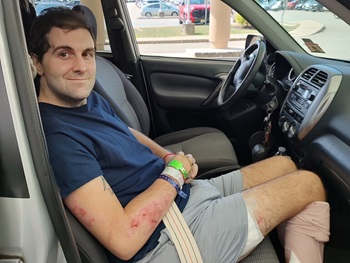
Codey's story

After serving tours of duty in Iraq, Kuwait and Dubai, Army Specialist Codey Vargas never imaged he’d fight his greatest battle off the field. Codey had many interests, from cooking, music and photography to travelling the world when time allowed.
Following his discharge, the 33-year-old was enjoying one of his passions – travel – in Costa Rica. But life took a sharp turn when he was in a terrifying motorcycle accident. He was rushed to a Costa Rican hospital and diagnosed with a traumatic brain injury, collapsed lungs and multiple rib fractures. Doctors performed a hemicraniectomy, a surgery to relieve pressure on his brain. And placed him in a medically induced coma for seven weeks to help him heal. Once stable, Codey’s mom had him transported to Jersey Shore Medical Center.
“I had brain surgery and had to relearn how to talk and walk again,” Codey said. “My memory was wiped and speech was gone.”
Codey survived a critical part of his recovery but needed further specialized care to rebuild his physical and cognitive skills. For that, his family chose Kessler Institute for Rehabilitation - West Orange.
His mom, Debra, was by his side every step of the way.
Over the next year he would spend approximately 16 weeks in inpatient rehabilitation.
Codey admitted to Kessler Institute for Rehabilitation unable to move independently due to neuromuscular impairments resulting from his brain injury. His sole means of communication was an occasional thumbs-up,
“I was hoping to regain my strength, walk again, speak again and be able to function at home as much on my own as possible,” he said.
At Kessler Institute for Rehabilitation, Codey’s physician-led team of therapists created a care plan to help him meet those goals with physical, occupational, speech and recreational therapies.
Codey’s initial stay in KIR - West Orange was focused on basic mobility and arousal. His therapists focused with sensory stimulation, including playing music intermittently during his therapy sessions in an attempt to increase his arousal and responsiveness. Gentle range of motion exercises and positioning also helped to keep him aroused. He worked on sitting balance and upright tolerance. But Codey soon began to experience setbacks due to fluid collecting on his brain. He went back to the hospital for two surgeries, one to install a shunt to drain the fluid and another to add a burr hole in his skull to further relieve pressure on his brain.
When Codey returned, his therapists noted that his strength was returning. His physical therapist (PT) helped him stand using a standing frame to support him.
Standing really got Codey excited to try walking again. For that, his PT used special body weight support systems to support his weight while he walked on the ground or on a treadmill. This allowed him to practice walking, balancing and shifting his weight with therapists by his side. They also taught Codey how to transfer between surfaces safely. For that he utilized a transfer board to create a bridge between two surfaces, such as a chair and bed, and slid himself from one surface to the other.
Codey was also making strides in occupational therapy during this time. His occupational therapist (OT) helped him to regain the strength in his upper body. It began with simple range of motion exercises such as arm circles and shoulder rotations. Not only was he getting stronger, he was becoming more alert, following simple instructions and beginning to communicate.
Codey was able to leave Kessler to continue recovery at home. Six months later, he had a common surgery to reconstruct his skull. After this surgery, he returned to Kessler.
This time, Codey’s communication had improved and the focus of his rehabilitation shifted to teaching him to dress, groom and use the bathroom safely. He learned how to incorporate adaptive tools like a sock aid and a reacher to make tasks easier.
In addition, OT sessions included mat mobility work such as kneeling and quadruped positions to build his core control. Again, Codey displayed his grit to the care team. To refine his reaching and grasping abilities, he used a special orthotic rehabilitation device that is spring loaded to help with grasping his fingers and moving his elbow. With time, he progressed to needing just supervision or contact guard assistance for most daily tasks.
Speech therapy was one of Codey’s biggest hurdles. When he arrived initially, he could barely communicate. He struggled but worked hard through memory strategies, voice exercises and problem solving tasks.
“Speech therapy taught me how to speak appropriately and I think communication is one of the most amazing things to have,” he said. “I started a journal to write things down and help with memory. That’s been huge.”
Beyond the structured therapy sessions, the Kessler approach tapped into Codey’s interests. He connected with Cypress, a facility dog. “I really enjoy animals,” he said. “Cypress helped with my workouts and balance, and I’d love to have a dog like that one day.”
He also took part in groups like Food for Thought, a group focused on promoting active engagement in a healthy lifestyle to support cognitive and physical health following a brain injury, and the Reconnecting After Brain Injury support group, both of which helped him regain confidence and socialize.
For Codey, each step — from standing up on his own to using the bathroom independently — was a breakthrough that reminded him he was making progress.
“It made me feel fulfilled,” he said. “Made me feel human again.”
When he completed his final few days at Kessler, his progress was evident. He was able to talk in a whisper voice, had vastly improved his memory, could perform most grooming and many functional activities with little help, could walk 100 feet with a rolling walker and he even learned to navigate four to six stairs with minimal assistance.
Support from his mother played a vital role in his recovery. A nurse herself, Debra helped care for him physically and emotionally.
“She’s my rock,” Codey said.
Upon discharge, Codey returned home with plans to continue therapy, first with home services and then outpatient care. He’s most excited to see more of his family, spend time with his mom and keep getting stronger.
“It’s been great,” he said about his experience at Kessler. “I worked with people who are really good at their job.”
More than just walking or speaking again, Codey rediscovered a new version of himself through this journey. He is able to cook weekly and still finds joy in photography.
“I learned to be patient at getting better,” he said. “You can restart your life if you’re patient. Working hard and having a positive attitude for sure helps.”